We Export the Ingredients and Import the Fuel. Queensland Can End That Trade.

By Allcap Securities Investment Team (24 March 2026)
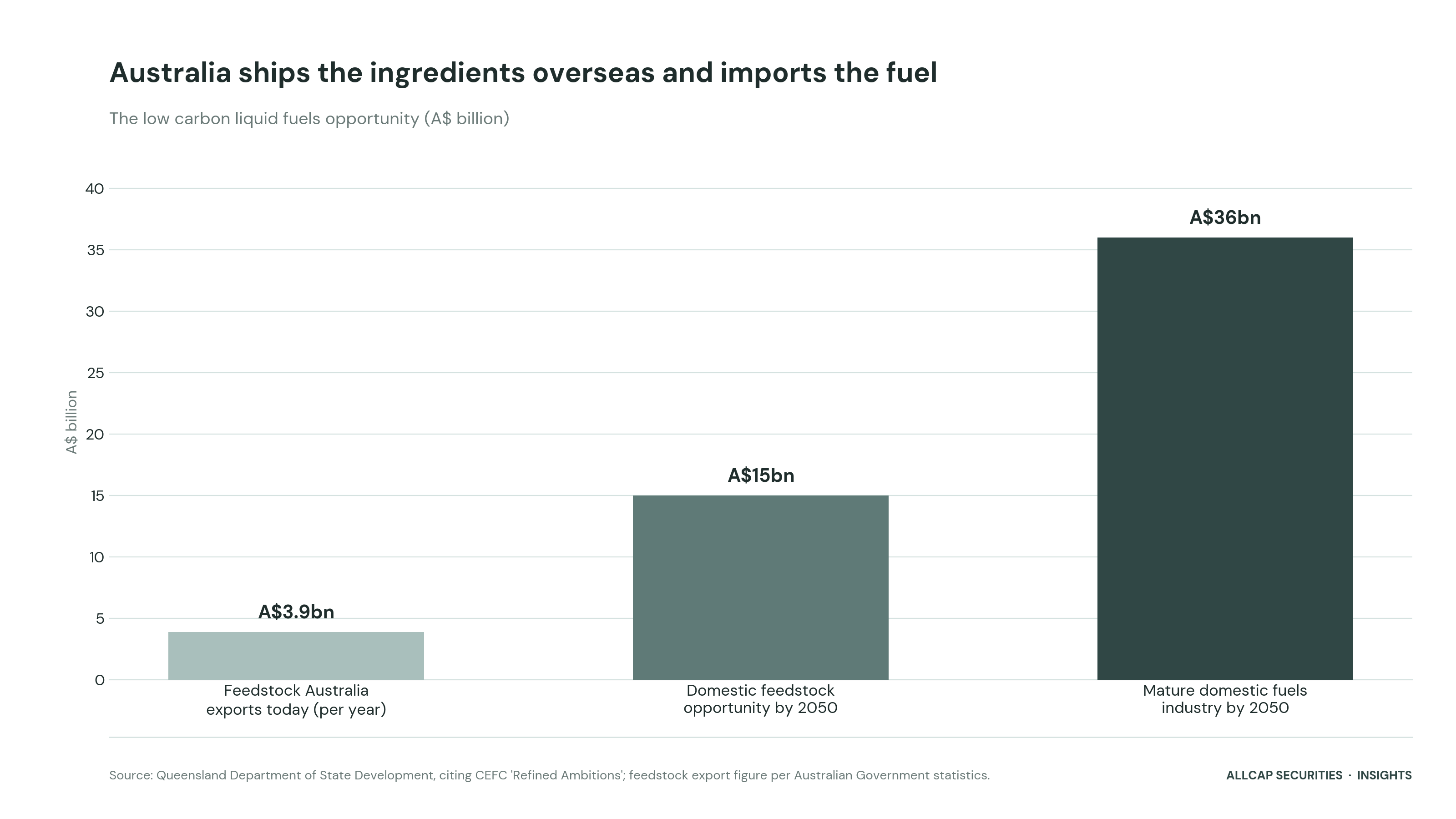
Australia does something odd with one of its most valuable resources. Every year we export around $3.9 billion worth of biofuel feedstock, tallow, canola, sugarcane by-products, so that other countries can turn it into fuel. Then we import the fuel. It is the resources equivalent of shipping out the wool and buying back the jumper.
That is starting to change, and regional Queensland is where the change is happening.
The policy door has opened
Last September the federal government committed $1.1 billion to a Cleaner Fuels Programme for domestic low carbon liquid fuels, on top of $280 million already channelled through ARENA and the Queensland Government's $181 million Sovereign Industry Development Fund. Last week in Townsville, business and civic leaders at the Secure the Future: Green Energy Forum went a step further, calling for a federal mandate that would require airlines to source a percentage of sustainable aviation fuel from domestic, regional producers.
The demand logic is hard to argue with. Australia burns through roughly 7 billion litres of aviation fuel and 30 billion litres of diesel a year, and aviation, freight, mining, maritime, rail and construction account for 80 per cent of all liquid fuel use. These are not sectors that will electrify quickly. Drop-in fuels that work in existing aircraft, trucks and machinery are the only realistic decarbonisation path for much of the economy, and the only realistic fuel security path for all of it.
The scale of the prize
The Clean Energy Finance Corporation has sized what a mature domestic industry could look like: $36 billion of low carbon fuels sold by 2050, built on a $15 billion domestic feedstock opportunity supplied largely by Australian agriculture. Queensland, with its cane, tallow and cropping base, is already the country's feedstock heavyweight.
The projects are moving from slide decks to steel. Jet Zero Australia, backed by Qantas, Airbus and the Queensland Government, is completing $75 million of engineering and early civil works on Project Ulysses in Townsville, targeting 113 million litres a year of sustainable aviation fuel and renewable diesel by 2028, with construction due to start this year. It is one of the largest proposed investments in that city in a quarter of a century, and it will not be the last.
Why this is an infrastructure story
Biofuels are usually framed as a technology or climate story. Look closer and they are an infrastructure story. Production plants need port access for feedstock and export. They need storage, pipelines and rail. They need reliable water, power and workforce accommodation in the regions where feedstock grows. Every one of those inputs is a long-life, contracted, real asset, exactly the category of investment that performs through cycles.
Australia has spent decades exporting the ingredients and importing the result. The capital, the policy support and the feedstock have finally lined up in the same place. The regions that build the plants, the storage and the export pathways will own a meaningful slice of the nation's fuel supply for the next fifty years.
References
- Townsville Enterprise, 'Leaders call for sustainable aviation fuel mandate', 16 March 2026 (townsvilleenterprise.com.au).
- Biofuels News, 'Jet Zero Australia welcomes funding to boost SAF development', 17 September 2025, on the $1.1 billion Cleaner Fuels Programme and Project Ulysses targeting 113 ML per annum by 2028 (biofuels-news.com).
- Queensland Department of State Development, 'Biofuels', citing CEFC report 'Refined Ambitions: Exploring Australia's Low Carbon Liquid Fuel Potential' (statedevelopment.qld.gov.au).
- LanzaJet, 'Sustainable Aviation Fuel Readies to Take Flight in Australia', 30 March 2023, on the Qantas, Airbus and Queensland Government-backed Australian SAF Partnership (lanzajet.com).