Foot Off the Brake, Eyes on the Storm: Investing Through the Uncertainty Cycle

By Allcap Securities Investment Team (27 May 2025)
When the Reserve Bank cut the cash rate to 3.85 per cent on 20 May, the second cut of the year, the headline was about mortgage relief. The more important story was in the statement's language. The Board noted that uncertainty in the world economy had increased, that volatility in financial markets had risen sharply, and that it had actively considered a severe downside scenario. Governor Michele Bullock was candid: the Bank is taking its foot off the brake, but only a little, and it remains ready to respond decisively if international developments turn.
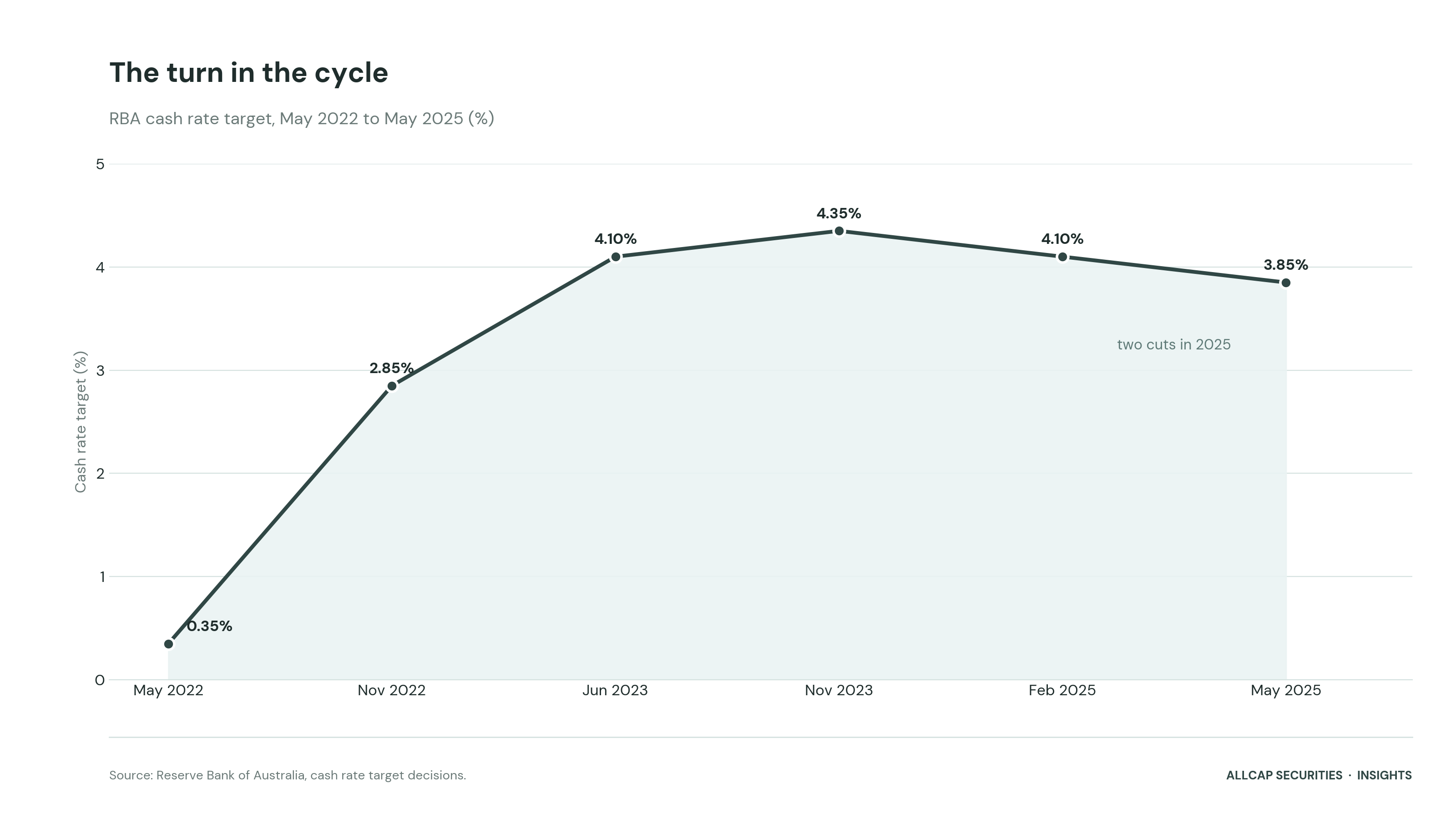
For investors, this is a peculiar environment. Inflation is back in the target band, rates are drifting lower, and yet the global backdrop, from tariff shocks to geopolitical flashpoints, is as unpredictable as it has been in years. The question is not whether to invest. It is what kind of risk deserves your capital when the rules of global trade are being rewritten in real time.
What holds value when forecasts do not
The past six months have been unkind to forecasters. Last October the WTO expected world merchandise trade to grow around 3 per cent in 2025. In April, after Washington's tariff announcements, it cut that to a 0.2 per cent contraction and published a downside scenario of minus 1.5 per cent. Within weeks, a 90-day tariff pause and a US–China truce in Geneva had markets pricing something closer to the October view again. Anyone who positioned a portfolio purely on the October view, or the April view, was wrong within weeks.
The lesson is not that forecasts are useless. It is that assets anchored to real, structural demand weather forecast errors far better than assets priced on a single scenario. A port that serves miners, farmers and energy projects does not stop earning because one trade corridor closes. Infrastructure with multiple demand drivers, contracted revenue and genuine scarcity value has historically absorbed exactly this kind of macro noise.
The regional Australia angle
There is a second tailwind that receives less attention than it should. Australia's infrastructure pipeline has never been larger. Infrastructure Australia's most recent Market Capacity Report puts the five-year major public pipeline at more than $200 billion, and warns that skilled labour, not funding, is now the binding constraint on delivery, with regional projects the most exposed. Queensland's own capital program stands at more than $107 billion over four years, with well over half of budgeted capital expenditure outside Greater Brisbane.
Capital that is positioned in the regions where this money is actually being spent, in port, rail, energy and accommodation assets with real counterparties and real demand, is not betting on a forecast. It is betting on work that governments have already budgeted for and workers who are already short in supply.
Discipline is the strategy
Periods like this reward a simple philosophy: protect capital first, insist on assets with structural demand, and invest where policy tailwinds and physical scarcity intersect. Markets will keep swinging between optimism and alarm. The underlying need to move freight, store energy and house workforces in regional Australia will not.
References
- Reserve Bank of Australia, Statement on Monetary Policy, May 2025, and monetary policy decision of 20 May 2025 lowering the cash rate target to 3.85 per cent (rba.gov.au).
- ABC News, 'Reserve Bank delivers 0.25 percentage point cut to cash rate in second interest rate reduction of 2025', 20 May 2025 (abc.net.au).
- World Trade Organization, Global Trade Outlook and Statistics, October 2024 and April 2025 editions (wto.org).
- Infrastructure Australia, '2024 Infrastructure Market Capacity Report', December 2024 (infrastructureaustralia.gov.au).
- Queensland Government, State Budget 2024–25, Capital Statement, June 2024 (budget.qld.gov.au).