Fifty Days of Fuel: Australia's Quiet Vulnerability and the Infrastructure That Fixes It
By Allcap Securities Investment Team (10 July 2025)
When Iran's parliament voted to close the Strait of Hormuz in late June, in response to US and Israeli strikes on its territory, the threat faded within days. The lesson should not. Around 20 per cent of the world's oil and a fifth of its liquefied natural gas pass through that narrow channel, and for a fortnight in June, analysts were warning that Australian bowser prices could hit $2.20 a litre if the crisis escalated.
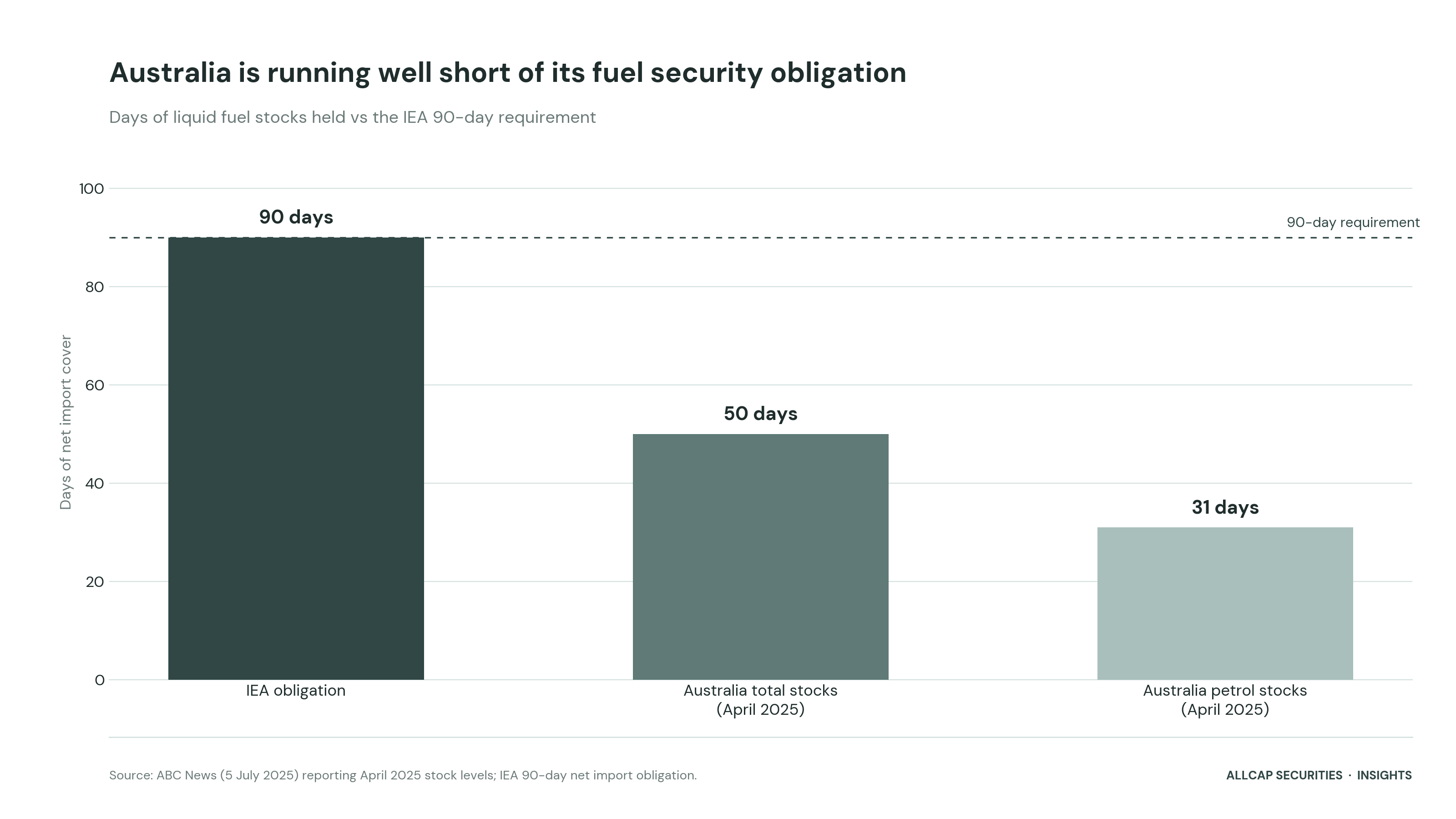
Australia's exposure is not just about price. It is about stock. As of April 2025, Australia held roughly 50 days of fuel reserves within the country, including just 31 days of petrol, according to reporting by the ABC. The International Energy Agency obligation Australia signed up to requires 90 days of net import cover. We have been short of that benchmark for years, and every Middle East flare-up is a reminder of how quickly a distant conflict becomes a local supply problem.
This is an infrastructure problem, not a policy memo
Closing the gap between 50 days and 90 days does not happen in Canberra press releases. It happens in physical assets: import terminals, tank farms, pipelines and distribution networks, located where ships can berth, land is available and demand is real. Strategic fuel storage is, at its core, a regional infrastructure opportunity.
It is also an investable one. Australia imports the large majority of its refined fuel, worth in the order of $38 billion a year, and successive energy security reviews have identified storage and import capacity as the weak link. Assets that solve a national security problem, with contracted offtake and regulated or utility-like demand profiles, sit squarely in the category of infrastructure that performs regardless of the macro cycle. In fact, the case for them strengthens precisely when the world becomes more dangerous.
Why regional Queensland
Few locations in Australia combine the prerequisites for strategic fuel infrastructure the way Central Queensland does. Gladstone offers a deep water port with existing bulk liquid handling, direct rail access to the inland, an industrial land base, and proximity to both mining demand and the agricultural heartland. It is already one of the nation's great import and export gateways. Extending that role into fuel import, storage and distribution is a natural evolution, not a speculative leap.
The same logic extends beyond traditional fuel. Biofuel production from regional feedstock, and the storage and export pathways it requires, leverages identical infrastructure. A region that can handle diesel and jet fuel today is the region best placed to handle the renewable fuels of the next decade.
The takeaway
Fuel security has moved from a technocratic footnote to a front page issue, and it will stay there as long as a fifth of the world's oil transits a chokepoint that can make the evening news. Building the storage and import infrastructure Australia needs is a decade-long task. For regional Queensland, and for investors with a long horizon, that is not a warning. It is an opportunity with a very long runway.
References
- ABC News, 'Global unrest threatens fuel security, but electric vehicles could ease oil dependency', 5 July 2025, citing April 2025 Australian stock levels of 50 days total and 31 days of petrol against the IEA 90-day requirement (abc.net.au).
- The Australia Institute, 'Over a Barrel: Addressing Australia's Liquid Fuel Security', on the IEA 90-day net import obligation (australiainstitute.org.au).
- US Energy Information Administration, 'Amid regional conflict, the Strait of Hormuz remains critical oil chokepoint', 16 June 2025 (eia.gov).
- Department of Climate Change, Energy, the Environment and Water, Liquid Fuel Security Review (Interim Report) and Australian Petroleum Statistics (dcceew.gov.au).